Saturday, September 10, 2022

My Tribute to Queen Elizabeth II (1926-2022)

Elizabeth Alexandra Mary Mountbatten-Windsor
(April 21, 1926 – September 8, 2022)

On September 8, 2022, the world changed. Queen Elizabeth II of Great Britain died, and though I was largely unaware of it throughout the day, the news struck me late that night. I had been at work with no way of knowing; I only have a flip phone, and no one mentioned it. I assumed it would be another mundane day, eager to return home and start my weekend. But past midnight, when I finally logged onto Twitter, I learned the news: the Queen was gone.

I was surprised. Her mother had lived to 101, and I thought she might do the same. Earlier in the day, I’d read a post saying the Queen was “resting comfortably” at Balmoral under medical supervision. Someone had replied that “resting comfortably” was code for the end. I hoped they were wrong, but alas, it was not to be. Death comes to us all, yet I could not imagine the world without her. I am still in my thirties, and she had reigned my entire life.

Because of the historical weight of her passing, I wanted to write this tribute. Others will pen far more eloquent reflections, but in my own words I hope to honor her memory and share what I have indirectly learned from her life.

By the time I was born in 1986, she had already been on the throne for 34 years. Growing up in the United States, I was largely indifferent to the monarchy. World history didn’t interest me until much later. The first time the Queen entered my awareness was after the death of Diana, Princess of Wales, in 1997.

I was 11 and knew little of Diana, but the television coverage was everywhere. On September 5, I remember watching the Queen’s live speech addressing the loss. She said:

“We have all been trying in our different ways to cope. It is not easy to express a sense of loss, since the initial shock is often succeeded by a mixture of other feelings: disbelief, incomprehension, anger, and concern for those who remain. We have all felt those emotions in these last few days. So, what I say to you now, as your Queen and as a grandmother, I say from my heart.”

Then she paid tribute to Diana as “an exceptional and gifted human being” whose smile, warmth, and devotion to her sons touched millions.

I watched from my room that afternoon, sensing this was history in the making. That was the first time I ever saw and heard the Queen speak.

For years afterward, I remained unaware of royal affairs. Then one Sunday in 2002, I came across a rebroadcast of the four-part PBS documentary “The Windsors: A Royal Family.” With little else on, I watched it all and I was captivated.

I learned how the family had German roots, prompting the change from “Saxe-Coburg-Gotha” to “Windsor” during World War I. 

I saw how Edward VIII abdicated to marry Wallis Simpson, and how George VI overcame insecurity and a stammer to lead Britain through its darkest days. His death saddened me, and I found myself believing he was one of Britain’s greatest kings.

Soon after, I watched “Bertie & Elizabeth," a television film about George VI and his wife. Together, these sparked a deeper interest in the monarchy. Without books of my own, I turned to the internet, but years later I found “Elizabeth the Queen: The Life of a Modern Monarch” by Sally Bedell Smith at a library book sale for two dollars. Though I have not yet read it, I still intend to.

Around that time, I also saw The Queen (2006) starring Helen Mirren. Later, I bought it on DVD. Watching it helped me see Elizabeth not just as a monarch, but as a human being carrying the weight of history.

My respect for her grew even more when “The Crown” premiered in 2016. 

Written by Peter Morgan, who also scripted The Queen, the series dramatized her reign with nuance and power.


One scene stood out above all: Queen Mary’s letter to her granddaughter upon George VI’s death. She wrote:

 Dearest Lilibet, I know how you loved your papa, my son, and I know you will be as devastated as I am by this loss. But you must put those sentiments to one side now, for duty calls. The grief of your father's death will be felt far and wide, your people will need your strength and leadership. I have seen three great monarchies brought down through their failure to separate personal indulgences from duty. You must not allow yourself to make similar mistakes. And while you mourn your father, you must also mourn someone else: Elizabeth Mountbatten. For she has now been replaced by another person: Elizabeth Regina. The two Elizabeths will frequently be in conflict with one another. The fact is...the crown must win. Must ALWAYS win.”

This struck me as a lesson about self-control: principles must guide us above emotions. The sovereign exists to embody stability, stoicism, and impartiality when the world falters. That was Elizabeth’s burden and her greatness.

Even in a monarchy that owns all the power, one must remain impartial and dedicated to your duty to watch over your country. The Queen may not have particularly approved of certain people’s candid display of deep inner emotion; however, it was not hers or any Sovereign's duty to indulge in somewhat of a very biased subject. The Sovereign's purpose is to remain strong, focused, and unaffected in such profound and contentious circumstances and to serve as a guiding model through crises, but also understanding enough to adapt to the changes brought by time.

Another scene that stood out was in episode 4 when a thick fog had fallen over London, and Queen Elizabeth went to see her grandmother Queen Mary to ask for advice on to how handle the crisis she was facing. Queen Mary tells her:

Monarchy is God’s sacred mission to grace and dignify the earth, to give ordinary people an ideal to strive towards; an example of nobility and duty to raise them in their wretched lives; monarchy is a calling from God.

That’s why you are crowned in an Abbey not in a government building, you are anointed, not appointed. It’s an archbishop that puts the crown on your head, not a minister or public servant, which means you are answerable to God in your duty, not the public.”


I liked this scene because of the way that Queen Mary, with her knowledge and breadth of experience, explained the necessity of a monarchy to her granddaughter. There were those who looked up to Queen Elizabeth II as a role model. I believe that she truly lived up to this view. I am saddened the Queen was the last or few left of the traditions, manners of her time and I do not see this role model quality or restraint in anyone else, except for King Felipe VI of Spain, who I also greatly admire. I hope that Queen Elizabeth’s successors to the throne of England will be able to carry the standard that she set for herself.

Through dramatization and history alike, I came to see Queen Elizabeth II as a servant-leader. For seven decades she bore her role with grace, dignity, and a deep sense of duty. In times of war, crisis, and change, she remained a symbol of continuity. As Winston Churchill once said of George VI, he could also have said of her: her “conduct on the Throne may well be a model and a guide to constitutional sovereigns throughout the world today and also in future generations.”

She was not without flaws, but her service outweighed her failings. We may never see another like her.

Her passing, and the series that illuminated her reign, stirred in me the same instinct I feel with the Kennedys: to collect, to preserve, to learn. I long to build a library of monarchs’ biographies—from the Plantagenets to the Windsors—but practical limits of income and space restrain me. For now, I have only a few, including Elizabeth the Queen and The Heir Apparent: The Life of Edward VII. It is enough to begin.

I will not predict how Charles III will reign or whether the monarchy will endure. Such speculations are for others. Instead, I remember a pledge Princess Elizabeth made on her 21st birthday in Cape Town in 1947:

I declare before you all that my whole life, whether it be long or short, shall be devoted to your service and the service of our great imperial family to which we all belong.”

Her Majesty fulfilled that pledge for seventy years. Under her scepter, the Crown always won.

Friday, August 26, 2022

Longing For School

Yesterday, August 25, marked thirteen years since the passing of Edward Moore Kennedy, Senator of Massachusetts for forty seven years and brother of President John F. Kennedy, Senator Robert F. Kennedy, and Ambassador Jean Kennedy Smith. He died at the age of seventy seven in 2009. I wanted to pay my respects when he lay in state at the John F. Kennedy Presidential Library and Museum, but at that time I was unable to go. I was in a very dark period of my life. I had just dropped out of school in my early twenties, and I felt completely unmoored. I had always hoped to meet Senator Kennedy. He had witnessed so much history, he had known ten presidents since entering the Senate, and he was the youngest of the siblings of his generation.

Yesterday was also the traditional Move In Day at Harvard University, when incoming first year students arrive on campus in late August. That sight made me sad as well. It reminded me of when I was a young college student full of anticipation. Now I feel like wasted potential. I wish I had their opportunities, their forward momentum. I sometimes fear that my possibilities are behind me, not ahead. Because of this, I decided to write a personal entry to confront something that has haunted me for years.

Several years ago, I left school for a mixture of reasons. I did not have enough money. I was not disciplined enough as a student. And the responsibility was my own. I cannot gloss over my failures. If I had worked harder, I would have finished. Instead I find myself trapped in a situation I do not know how to escape.

When I entered college as a first year student at the age of twenty, I was frightened. I had been bullied in high school and feared it would continue. I was shy and timid. To my surprise, I became well known on campus over the next three years. I developed an interest in politics, and both professors and students encouraged me to pursue that path. I listened to speeches by John F. Kennedy, Martin Luther King, and Bill Clinton, memorized their words, studied their techniques, and drew inspiration from their messages. People jokingly called me Mister President. I often shook hands the way a politician does while campaigning. I tried to be friendly to everyone, though not all friendliness was returned. For the first time in my life, I felt valued. At home I was seen as an outcast for wanting deeper conversation and intellectual challenges, but on campus I felt that I belonged and that a future was possible.

I loved school so deeply that I hated returning home for holidays and summer breaks. I felt confined among my small minded relatives. Each return home felt isolating. I longed for campus life. I miss the diversity of thought and the freedom people felt to express themselves. I crave an outlet where I can engage with ideas and learn in a peer centered environment. Sharing ideas with classmates taught me that the world was much larger than my hometown. I dreamed of graduating in 2010, traveling to places like Rome, and even one day meeting President Obama in the Oval Office. Even the difficult days felt meaningful because they were part of a promising path.

The greatest day of my college years was December 2, 2008, when I met Senator John Kerry of Massachusetts. He came to my college for a public discussion on the economy. Before he arrived, I asked my friend Meagan, who had a camera, to take a photo of me with him. Senator Kerry walked in at six thirty to applause. I thought, “It is really him.” After the mayor introduced him, he spoke for about an hour, then took a few questions. He mentioned he had to leave for an event in Charleston. I told myself, “You are not leaving until I get that picture.” When the meeting ended, most of the crowd moved toward the front entrance, leaving space near the doorway. As he stepped out, I called, “Senator.” He looked up. I hurried toward him and said quietly, “I am actually down here.” When I had his attention, I asked if I could have a picture. He said, “Oh sure.” I shook his hand and motioned to Meagan to take the photo. Afterward he said, “Good luck in school.” I replied, “Thank you, Sir,” and we shook hands again.

I was elated for the rest of the year. I had just shaken hands with a man who debated President George W. Bush, sailed with President John F. Kennedy, worked with Senator Ted Kennedy, campaigned with President Bill Clinton, and supported Barack Obama. I watched videos of his speeches the very next day, still amazed. Some people told me this encounter would push me further toward politics, and they may have been right. I was at the height of my happiness. Those were the best years of my twenties.

But the happiness faded. I procrastinated. I focused on courses I enjoyed and ignored those I did not. I spent too much time on my social life because I was filling the emotional void left by unloving relatives. These are not excuses, but they explain my mindset. I was placed on academic probation. With no remaining money for school, I had to withdraw. I was devastated. I felt as if my life had ended. I knew the uphill battle to return to school would feel as impossible as climbing Mount Everest. The pain came from knowing I was capable of more. I had deluded myself into fantasizing about greatness instead of disciplining myself to earn it.

In the years that followed, I attended forums and lectures during days off from my job as a dishwasher. Those opportunities allowed me to meet three governors of my state, two senators, two mayors, two congressional representatives, two ambassadors, a prime minister from another country at Harvard University, four presidential candidates, and even to receive a letter from President Obama in early 2017. These moments brought intellectual stimulation and gave me temporary relief from the reality of being a college dropout. They were small triumphs. But I still felt inadequate compared to my former classmates who had moved forward in life. I felt like a fraud when posting photos on Facebook. People assumed I had a career in politics, when in truth I was struggling in obscurity.

Almost a decade after leaving school, I moved closer to the Boston area because my college friends urged me to start fresh, find better work, and eventually return to school. But even now I am still stuck, without money to continue, and with few prospects. Each day I fear I have no future. I often wonder if my existence still matters. I do not want to live an aimless life working joyless jobs for ungrateful people. More than anything, I want to return to school.

What hurts even more is how I have tortured myself for not finishing my degree. I now live four miles from Harvard University, a place where eight presidents graduated. At first, I visited the campus to find peace, to be surrounded by history and academic energy. But recently it has become a place where I mourn my failures and worry that I am running out of time. It is a place I love and hate at the same moment. It represents everything I desire and everything I feel barred from.

One weekday afternoon, after a job interview near the campus, I walked through Harvard Yard and saw a group of students seated in a circle with a professor leading a discussion. I wanted to sit nearby, take notes, and listen. But I knew I was not a student, and I would not belong there. I later walked through the Harvard Kennedy School and saw students eating together, laughing, sharing camaraderie. I wished I was fifteen years younger and part of their world. I walked away, feeling wounded, and cried alone where no one could see me.

On another night in the spring, unable to sleep, I walked more than four miles from my apartment to Harvard Yard. It was past two in the morning. Students were still out talking near the statue of John Harvard. I sat on the steps of Memorial Church, looking across at Widener Library, thinking about my life. A young couple walked hand in hand up the library steps, laughing and chasing each other. Their joy sharpened my awareness of my own loneliness. I have never married or even had a girlfriend, and I mourn the emotional wounds that make it hard for me to open my heart. After hours of silent tears, I walked back home drained and defeated.

This was a difficult entry to write. I had to confront myself honestly for the first time in a public way. I also feared that future employers might see this and judge me unfit for work in government, education, museums, or universities. But I needed this outlet. Writing helps me steady my emotions and try to heal my mind. Even now I feel I have not fully captured the depth of my sadness. I may return to edit this entry in the future.

Above all, I want to return to school, finish what I began, redeem the time I wasted, and finally graduate. I know there will be challenges. I will be older than most of my classmates, and I will probably feel alone, but I will also be more focused. I hope that when I do return, I will find clarity about what comes next. I want to become a historian like David McCullough, one of my heroes. I dream of writing and publishing at least nine books, and perhaps meeting presidents and world leaders along the way.

I struggled to find a proper conclusion for this entry, so I turned to the words of Senator Edward M. Kennedy, spoken at the John F. Kennedy School of Government at Harvard on October 25, 1991. He acknowledged his failures and promised to do better. If he could strive for redemption as he faced tragedy and public scrutiny, perhaps I can strive as well. He understood humiliation, suffering, and being underestimated, even within his own family. His story reminds me that becoming better is always possible.

He said, “Individual faults and frailties are no excuse to give in and no exemption from the common obligation to give of ourselves. I feel a special obligation to those who share my hopes for this state and nation who in the past have given me their help and often their hearts. My views on some issues have made some people angry over the years and I accept that as the price of fighting hard for my beliefs. I am painfully aware that the criticism directed at me in recent months involves more than honest disagreements or the usual objections from the far right. It also includes the disappointment of friends and many others who rely on me to fight the good fight. To them I say that I recognize my shortcomings. I realize that I alone am responsible for them and that I must confront them. Today more than ever before, I believe that each of us must struggle not only to make a better world but to make ourselves better too. And in this life, those endeavors are never finished.”

Friday, August 12, 2022

My Tribute to David McCullough (1933-2022)

David Gaub McCullough

(July 7, 1933 – August 7, 2022)

Seventy years ago, on August 7, 1952, President Harry S. Truman held his 311th press conference in the Indian Treaty Room of the Executive Office Building. While much of the nation focused on the upcoming election, Truman spoke of a terrible drought and, more pointedly, of a different crisis: over 29 million adult Americans were not registered to vote.


“The privilege of voting is one of the most treasured rights on earth,” he reminded his audience. “But we cannot have a big vote in this country without a big registration.”

I grew up in Framingham, Massachusetts, thirty-six miles from Hingham. My parents did not instill a love of history, but through PBS programs narrated by David McCullough, a seed was planted.

I first heard his voice in middle school during Ken Burns’ The Civil War. While classmates grew restless, I was transfixed. His narration carried reverence and intimacy, unlike anything I had ever experienced.

In February 2001, I stayed up late to watch “Abraham & Mary Lincoln: A House Divided,” For the first time, I saw Lincoln and Mary Todd not as marble figures but as human beings. Lincoln’s struggle with depression mirrored my own feelings, and McCullough’s voice gave those struggles dignity. I recorded the series on VHS and watched it often. It became a quiet balm while my parents divorced.

Years later, in college, I briefly studied film, thinking I wanted to direct. But I soon realized what I loved were the stories themselves, especially historical ones.

In 2008, I watched the HBO documentary David McCullough: Painting With Words.” Seeing his life and work laid out with such purpose, I knew I wanted to do what he did. I switched my major to history. My professors praised my papers and encouraged me. But I lacked the money to continue, struggled with required courses I didn’t care for, and eventually dropped out.

That failure led to years of depression and dead-end jobs. Yet McCullough remained a lifeline. At library sales I picked up 1776, John Adams, and Truman for a few dollars each. They weren’t just books to me, they were companions. His words gave me hope that history might still have a place for me.

In 2015, the John F. Kennedy Presidential Library and Museum hosted a forum featuring McCullough speaking on The Wright Brothers. I registered at once.

The day of the event, errands delayed me. By the time I arrived, the lecture had ended and the book signing had begun. I bought a copy of The Wright Brothers in the gift shop and joined the long line, nervous but determined.


I even let people pass me, wanting to be last. At one point I offered my place to a kind woman leaving Smith Hall, only to realize later that she was Rosalee, McCullough’s wife. The embarrassment still lingers.

When I noticed his son Geoffrey nearby, I asked if he might take a photo of me with his father. He kindly agreed. When my turn came, Geoffrey said, “Hey Dad, look up and smile. There’s a young man here who wants a picture with you.”

McCullough looked up, smiled warmly, and asked, “Oh? Do I know who he is?” I laughed nervously, but in that instant, I felt seen. Geoffrey snapped the photo. My quiet dream had come true.

I never met him again. Over the next seven years, I collected more of his works and revisited the places he wrote about: Quincy for John Adams, the JFK Library, local celebrations of American history. His words remained a companion, especially during lonely stretches of life.

McCullough often warned of historical illiteracy. In 2011, he told the Wall Street Journal how shocked he was when a college student confessed they hadn’t realized the thirteen colonies were all on the East Coast. He worried that too few Americans knew their own past.

He believed history should not be taught as a chore but as a source of joy. “History isn’t just something that ought to be taught because it will make us better citizens,” he said. “It will make us more thoughtful and understanding human beings. The pleasure of history, like art or music, consists in an expansion of the experience of being alive.”

That philosophy has become mine as well.

From McCullough I have four signed books and a single photograph. But his greater gift is harder to hold: the lessons, the inspiration, and the sense that history can be written with dignity and wonder.

He painted with words. He reminded us that ordinary people can live extraordinary lives. Through his books and his voice, he became my teacher, my mentor, and my quiet companion in lonely seasons.

As Edwin Stanton said of Abraham Lincoln, so too it can be said of David McCullough: “Now he belongs to the ages.”

David McCullough painted with words, not just to inform, but to inspire. He reminded us that ordinary people could live extraordinary lives—and that history, when written with care and reverence, could become a form of art. Through his books and his voice, he became my teacher, my mentor, and a quiet companion in my loneliest seasons. I hope to carry forward a portion of his spirit in the life I’m still building.

As Secretary of War Edwin Stanton said of President Abraham Lincoln when Lincoln breathed his last, so true it will be said of David McCullough: "Now He Belongs To The Ages."

I want to end with a passage from "The American Spirit: Who We Are and What We Stand For," a collection of his speeches:

“The lessons of history are manifold. Nothing happens in isolation. Everything that happens has consequences. We are all part of a larger stream of events, past, present, and future. We are all the beneficiaries of those who went before us — who built the cathedrals, who braved the unknown, who gave of their time and service, and who kept faith in the possibilities of the mind and the human spirit.

A sense of history is an antidote to self-pity and self-importance, of which there is too much in our time. To a large degree, history is a lesson in proportions.”

David McCullough gave us those proportions. Now it is our turn to carry them forward.


Friday, June 17, 2022

Update To My Kennedy Book Collection (2022)

It has now been two years since the passing of Jean Kennedy Smith (1928-2020), and I wanted to do something to honor her memory. So, I thought I would create a blog entry on two new acquisitions to my Kennedy Book Collection, which I have referred to as my "Kennedy Corner." This is the first update on my collection I have published as a blog entry since October 25, 2021, which totals to 7 months and 42 days. I will admit that in my previous update that I would not buy another book on the Kennedys since I have been running out of room for the collection and wanted to save money. I have no excuses. I just wanted to get just two more books.

The first book I acquired was a book called "Farewell, Jackie: A Portrait of Her Final Days" by Edward Klein. I initially did not want to order it because it has so many negative reviews. There are charges that some sources used were "anonymous," which leads me to suspect that there may be inaccuracies and omissions in this book. Nevertheless, against my own judgement, I decided to order because I only have four books specifically about Jacqueline Bouvier Kennedy Onassis and wanted to add at least one more on her to add to my collection.

The book arrived last week on June 7th, and I have placed it in my top shelf with the smaller hardcover books I have on the Kennedys. I placed it on the top right next to my copies of “The Nine of Us: Growing Up Kennedy” by Jean Kennedy Smith (signed by the author), “The Kennedy Brothers: The Rise and Fall of Jack and Bobby” by Richard D. Mahoney (which my friend Mai Lee gave to me) and a vintage WA Smith chalkware bust of First Lady Jacqueline Kennedy (a companion piece to the chalkware bust of her husband). I thought it was fitting since the book was placed next to a bust of its main protagonist.


The second and final book I acquired was a copy of “Public Papers of the Presidents - John F. Kennedy 1961,” which arrived five days ago on June 13. I was also not going to purchase it because I thought it would be too expensive for my small budget. However, the seller on Ebay offered to sell it to me for ten dollars less than its original price. I knew I could not get a better deal anywhere else since the seller’s original price on Ebay was thirty dollars less than the actual retail price, so I agreed to purchase it.

According to the Office of the Federal Register (OFR), “each Public Papers volume contains the papers and speeches of the President of the United States that were issued by the Office of the Press Secretary during the specified time period. The material is presented in chronological order, and the dates shown in the headings are the dates of the documents or events.” In other words, my copy of “Public Papers of the Presidents - John F. Kennedy 1961,” has every speech and press conference transcripts that President Kennedy stated in 1961 that has been allowed to be made public.

For a person, who aspires to be a scholar on President Kennedy this is a must have item. I wish I could acquire all three hardcover volumes from 1961 to 1963, but that would be far too expensive for me to purchase so I will have to settle with just my 1961 volume of Kennedy’s public papers. I am apt to believe that it will help me later on if I am ever writing a paper on President Kennedy for whenever I return to school, I could use it as a primary source and maybe for future writing projects as well.  

I have also recently acquired two more hardcover copies of “JFK: Coming of Age in the American Century, 1917–1956,” written by Pulitzer Prize winning historian Fredrik Logevall, who teaches History at Harvard University, where John F. Kennedy studied and graduated from in 1940. 

I had already acquired a copy last year, but I decided to get two more for two different reasons. I purchased one copy that I could take with me read one on sunny and warm afternoons at John F. Kennedy Memorial Park in Cambridge, Massachusetts. I also thought it would be amusing to read a Kennedy book by historian who teaches at the university Kennedy graduated from in a Kennedy Park behind a school of government named after Kennedy near the grounds where he attended university as a student.


Another reason for the acquisitions of the two copies is because at a previous job in a nursing home nearby, I became friends with a retired Harvard University professor and have brought books to give to him since he didn’t like any of the reading materials the nursing home offered. I thought a book by a colleague he never met would be an interesting gift to give to him. I hope he likes the book. I’ll have to begin reading it myself and with the summer now upon us at this time of year, it would be appropriate to put the book to my summer reading list.

Since this is also the anniversary of the passing of Jean Kennedy Smith, I wanted to write some thoughts on what meeting her had indirectly done for me. As I have written before, in meeting her I felt as though that was as close as I would get to meeting her brothers, including President Kennedy. 


She also inspired me to take an interest in learning more about the world around us, particularly events in Europe and Asia and in promoting global diplomacy and world peace as her brother President Kennedy hoped would come to pass in his lifetime. Both President Kennedy and Ambassador Smith inspire me to this day in looking to the past for inspiration and to glean knowledge from their experiences in global affairs. I hope that I can one day contribute to the work they set out to do while they were alive and honor their legacies so that their names can live on.

I want to conclude this blog entry with the final remarks that President Kennedy delivered to the United Nations General Assembly on September 25, 1961:

But I come here today to look across this world of threats to a world of peace. In that search we cannot expect any final triumph--for new problems will always arise. We cannot expect that all nations will adopt like systems--for conformity is the jailor of freedom, and the enemy of growth. Nor can we expect to reach our goal by contrivance, by fiat or even by the wishes of all. But however close we sometimes seem to that dark and final abyss, let no man of peace and freedom despair. For he does not stand alone. If we all can persevere, if we can in every land and office look beyond our own shores and ambitions, then surely the age will dawn in which the strong are just and the weak secure and the peace preserved.

 Ladies and gentlemen of this Assembly, the decision is ours. Never have the nations of the world had so much to lose, or so much to gain. Together we shall save our planet, or together we shall perish in its flames. Save it we can--and save it we must--and then shall we earn the eternal thanks of mankind and, as peacemakers, the eternal blessing of God.”

Monday, October 25, 2021

A Final Update To My Kennedy Collection (For Now)

Today is the 60th Anniversary of when a renowned Two-time Pulitzer Prize winning author, poet, and historian Carl Sandburg met with President John F. Kennedy at the White House on October 25, 1961. 

In my opinion, Carl Sandburg was one of the great contributors to American art, music and literature, especially with his six-volume biography of Abraham Lincoln. In my book collection, I have a one volume abridged edition of “Abraham Lincoln: The Prairie Years & the War Years (Library of the Presidents),” which I purchased at the Brattle Book Shop in Boston several years ago. My admiration for Mr. Sandburg deepened when I saw a PBS documentary about him called “The Day Carl Sandburg Died,” which really isn’t about his death at all, but rather tells the story of his interesting and unique life.


Apart from this, it has also been one month and seven days since I last updated this blog and also three months and one day since I gave an update on my Kennedy Book Collection. Since today was the anniversary Mr. Sandberg’s meeting with President Kennedy, I decided that tonight would be an appropriate time to update my blog and share with the reader on what books on the Kennedys I have acquired since then. To be honest, I cannot recall in detail on my inventory of Kennedy books that I acquired because I did not make time to document it. Because of it, I will do my best to recount from memory.

Since the end of July, I ordered and received hardcover copies of:

  • Jack: A Life Like No Other” by Geoffrey Perret
  • Kennedy and Roosevelt: The Uneasy Alliance” by Michael R. Beschloss
  • One Hell of a Gamble: Khrushchev, Castro and Kennedy, 1958–1964” by Aleksandr Fursenko and Timothy Naftali (not pictured)
  • One Minute to Midnight: Kennedy, Khrushchev, and Castro on the Brink of Nuclear War” by Michael Dobbs.
  • The Kennedy TapesInside the White House During the Cuban Missile Crisis” Edited by Ernest R. May and Philip D. Zelikow
  • “JFK and the Masculine Mystique: Sex and Power on the New Frontier" by Steven Watts (not pictured)
  • “JFK's Forgotten Crisis: Tibet, the CIA, and the Sino-Indian War” by Bruce Riedel
  • “John F. Kennedy (The American Presidents #35)by Alan Brinkley
  • “Mrs. Kennedy: The Missing History of the Kennedy Years” by Barbara Leaming
  • “Jacqueline Kennedy: First Lady of the New Frontier” by Barbara A. Perry
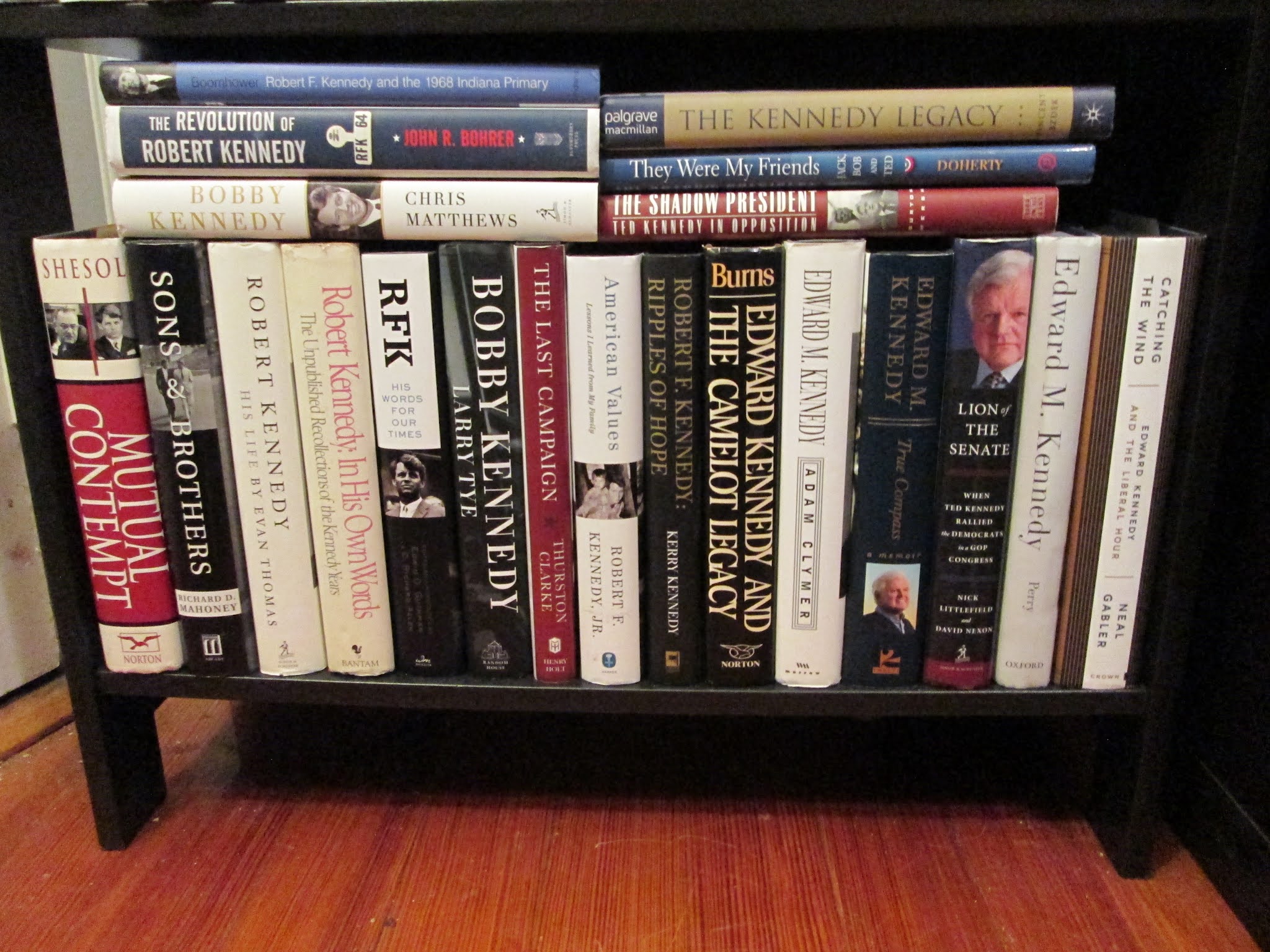
  • “Mutual Contempt: Lyndon Johnson, Robert Kennedy, and the Feud that Defined a Decade” by Jeff Shesol


While I did not make an update for this blog, I did post an update on August 7 in a Facebook group of Kennedy Devotees called “The History of the Kennedys.” When I rediscovered my post from that time (which I had forgotten I had posted), I was finally able to recount my inventory with some accuracy.

Those were intended to be my final books for now. However, I received a surprise comment to my August 7th post from an author by the name of Thomas Maier, who wrote a book called “The Kennedys: America's Emerald Kings: A Five-Generation History of the Ultimate Irish-Catholic Family” which was originally published on September 22, 2003. He suggested that I buy a copy of his other book “When Lions RoarThe Churchills and the Kennedys,” which was published on October 28, 2014. Since I felt honored that he reached out to me, I replied that I would order the book, looked forward to reading it, and adding it to my collection. Upon ordering the book, it became the last book I would ever order online of the Kennedy Family as my book shelf was already become full.


However, since the end of August, only four more books were unintentionally added to my collection. One night when I was cleaning out my room, I found my hardcover copy of “Kennedy & Nixon: The Rivalry That Shaped Postwar America” by Christopher Matthews. I felt relieved that I didn’t have to order it. 

About a month later, I traveled to the Framingham Public Library and I discovered bought a copy of “A Lady, First: My Life in the Kennedy White House and the American Embassies of Paris and Rome” by Letitia Baldrige and “A History of the Kennedy Space Center” by Kenneth Lipartito and Orville R. Butler for $2.00 each.

The final book I purchased was “Jack Kennedy: Elusive Hero” by Chris Matthews, which I purchased this morning for only three dollars on my final visit to the Framingham Public Library for this year. I had purchased another copy of the book years ago from the same library for the same price, but I had misplaced it. When I found the book today, I knew I had to bring it to my apartment near Boston and have it become the final book to add to my Kennedy bookshelf… for now.


As I mentioned in another blog entry, I am going to put a hold on buying Kennedy books to add to my Kennedy book collection as I don’t want to have too many books and need to save money. I know that there are more books out on the Kennedys that I have yet to discover, but there are only two more books I wish to purchase upon their future publication. The books are the second volume of Frederik Logevall’s biography of President John F. Kennedy and the second volume of Neal Gabler’s biography of Edward M. Kennedy. It will be some time before they are published because the authors are still working on them, but I will wait until them. Besides, I think I have more than enough books on the Kennedys that I can use as a reference and need to make time to read. 


In addition to putting a hold on buying Kennedy books, I have also placed myself on a book buying ban. As a bibliophile, I have a bad habit of impulsively overspending on books even though I bought most of my books for under ten dollars each and at bargain prices. Despite this, I’ve realized that I have too many books that I have not read, but many more that I want to buy. I have been piling up book and many are untouched. I’ve decided that I need to make time to read that books that I own and to glean knowledge from their pages. Another reason is that I need to save money for other important things like bills, food, rent, and so on and my saving may be needed in case of a financial emergency. I will have to avoid going to bookstores and libraries as well. By spending time reading the books that I already own and in saving money, I believe this will be of better benefit as a whole. Gleaning knowledge from my books and sharing what I have learned with others who might be interested will be its own reward. After all if JFK took the time to read, I should too.


With nothing more to say, I want to end this blog entry with a quote. I have debated if I should use the words of John F. Kennedy or some other historical figure to somehow wrap up this blog entry. However, this isn’t really a blog entry about him, but about my journey collecting books about him and his family that is coming to an end… for now. After some searching, I came upon these words from a homeowner named Thea Beasley (with no connection to the Kennedy family): “All these things we find are pieces of ourselves. I’ve built a future by rummaging through the past.”